
README.md 4.6 KB
Pysketcher
Tool for defining sketches of physics problems in terms of Python code.
Purpose
Pysketcher can typically be used to draw figures like
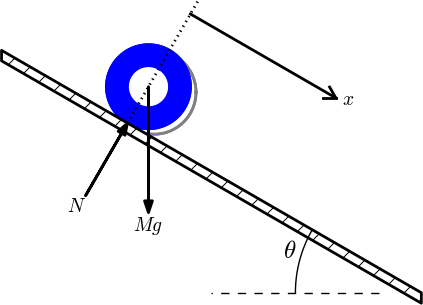
Such figures can easily be interactively made using a lot of drawing programs. A Pysketcher figure, however, is defined in terms of computer code. This gives a great advantage: geometric features can be parameterized in term of variables, as here:
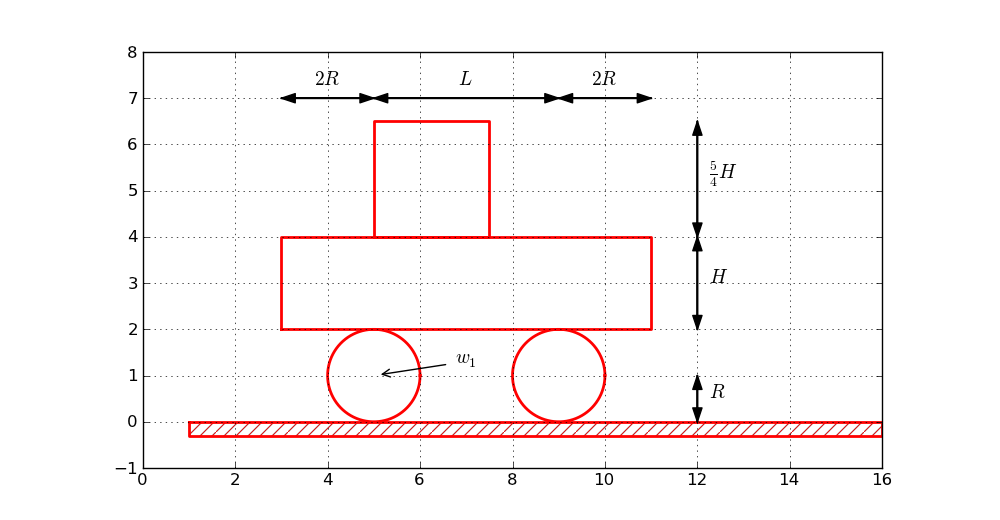
One can then quickly change parameters, here to
R=0.5; L=5; H=2 and R=2; L=7; H=1, and get new figures that would be
tedious to draw manually in an interactive tool.

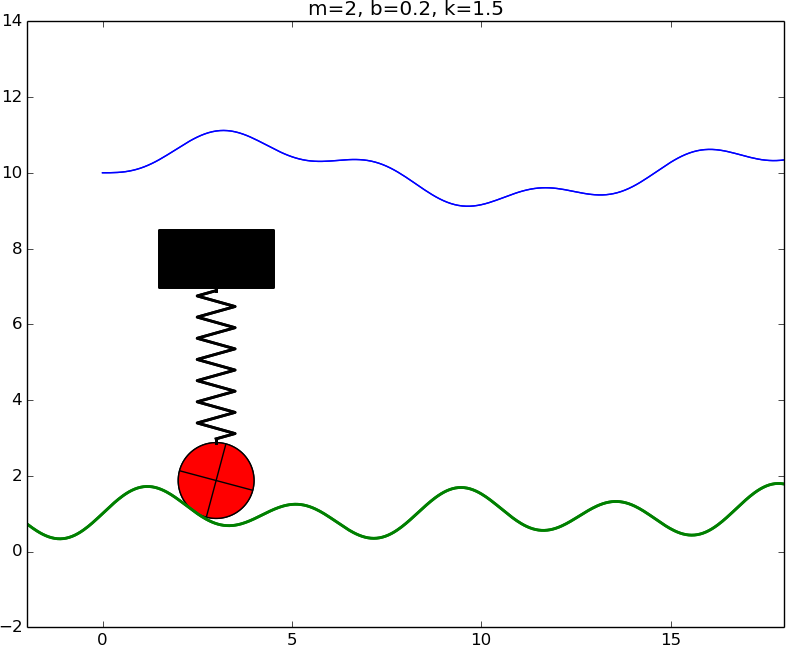
Another major feature of Pysketcher is the ability to let animate the sketch. Here is an example of a very simple vehicle on a bumpy road, where the solution of a differential equation (upper blue line) is fed back to the sketch to make a vertical displacement of the spring and other objects in the vehicle, view animation (the animation was created by this Pysketcher script).
Tutorial
For an introduction to Pysketcher, see the tutorial in HTML, Sphinx, or PDF format (or a simplified version of the tutorial in Chapter 9 in A Primer on Scientific Programming with Python, by H. P. Langtangen, Springer, 2014).
Examples
See the examples directory for some examples beyond the more basic
ones in the tutorial.
For example, a pendulum and its body diagram,
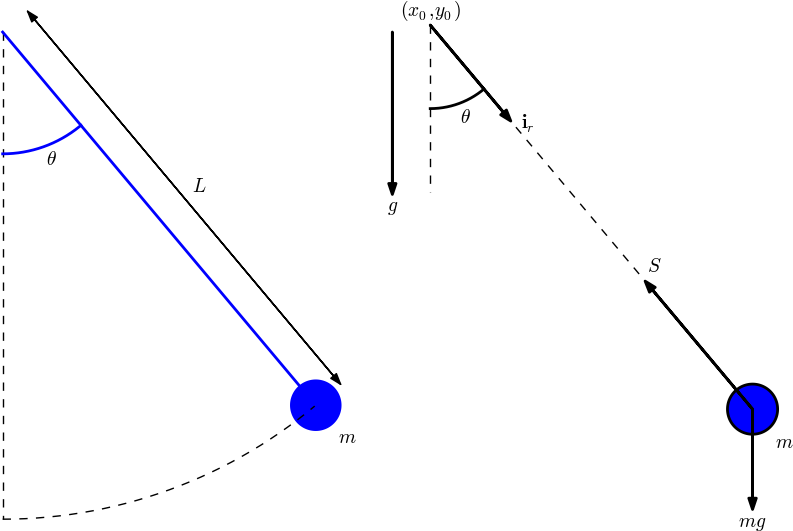
can be created by the program examples/pendulum.py.
Technology
Pysketcher applies Matplotlib to make the drawings, but it is quite
easy to replace the backend MatplotlibDraw.py by similar code utilizing
TikZ or another plotting package. The Pysketcher software is a thin
layer basically constructing a tree structure of elements in the
sketch. A lot of classes are offered for different type of basic
elements, such as Circle, Rectangle, Text, Text with arrow, Force,
arbitrary curve, etc.
Complicated figures can be created by sticking one
figure into another
(i.e., hierarchical building of figures by sticking one tree
structure into another).
Citation
If you use Pysketcher and want to cite it, you can either cite this web site or the book that has the original documentation of the tool.
BibTeX format:
@book{Langtangen_2014,
  title = {A Primer on Scientific Programming With {P}ython},
  author = {H. P. Langtangen},
  year = {2014},
  publisher = {Springer},
  edition = {Fourth},
}

@misc{Pysketcher,
  title = {{P}ysketcher: {D}rawing tool for making sketches},
  author = {H. P. Langtangen},
  url = {https://github.com/hplgit/pysketcher},
  key = {Pysketcher},
  note = {\url{https://github.com/hplgit/pysketcher}},
}
Publish format:
* books
** A Primer on Scientific Programming With {P}ython
   key:       Langtangen_2014
   author:    H. P. Langtangen
   year:      2014
   publisher: Springer
   status:    published
   edition:   Fourth
   entrytype: book
* misc
** {P}ysketcher: {D}rawing tool for making sketches
   key:       Pysketcher
   author:    H. P. Langtangen
   url:       https://github.com/hplgit/pysketcher
   status:    published
   sortkey:   Pysketcher
   note:      \url{https://github.com/hplgit/pysketcher}
History
Pysketcher was first constructed as a powerful educational example on object-oriented programming for the book A Primer on Scientific Programming With Python, but the tool quickly became so useful for the author that it was further developed and heavily used for creating figures in other documents.